How a Retired Sickle Cell Nurse Helped Me Cut My Son's Crises in Half — Using a Simple 30-Day Home Protocol Nobody Told Me About

If you are the parent of a sickle cell child and you have sat in a hospital waiting room more times than you can count — read every word on this page.
If you have watched your child cry through a pain crisis and felt completely helpless — read every word on this page.
If you have left a hospital appointment holding a piece of paper that explained almost nothing — read every word on this page.
If you have spent money you didn't have on medications, consultations, supplements, and herbal remedies — and your child is still crising — read every word on this page.
Because I know what it feels like to lie awake at 2am listening for sounds from your child's room.
I know what it feels like to tell your boss "family emergency" for the third time in six months and watch their face change.
I know what it feels like to hold your child's hand while a nurse puts a drip in their arm — and think: why is this happening again? What am I doing wrong?
I know what it feels like to Google "how to prevent sickle cell crisis" at midnight and find nothing but American medical journals written for doctors — not for a terrified Nigerian mother sitting in the dark.
I know what it feels like to read a discharge letter that says "rest and stay hydrated" and want to scream — because you have been doing that. You have been doing everything they told you. And it keeps happening anyway.
The pain crises keep coming. The hospital admissions keep coming. The guilt keeps coming.
And nobody — not one doctor, not one nurse, not one specialist — has ever sat with you for a full hour and explained what is actually happening inside your child's body. And what you — at home, in your kitchen, in your daily routine — can actually do about it.
Until now.
"I know. Because I carried it too. For six years, I carried it. And then one afternoon, a woman who had spent forty years watching sickle cell children told me the truth that changed everything."
My name is Ngozi Adeyemi.
I am not a doctor. I am not a nurse. I am not a sickle cell specialist with a certificate on the wall.
I am a mother who spent six years inside this problem — trying everything, spending everything, and still sitting in that hospital car park crying while my son slept in the back seat after his third crisis admission in fourteen months.
My son was confirmed SS genotype at birth. We knew it was coming. My husband and I both knew our genotype before we married. We made the decision together. And when Emeka arrived — perfect and loud and beautiful — we told ourselves we would manage it. We would stay on top of it. We would be the parents who did everything right.
We had no idea what "everything right" actually meant. Because nobody told us.
The hospital gave us folic acid. They gave us a pamphlet. They gave us a follow-up appointment three months away. And they sent us home.
For the first two years, Emeka was relatively stable. One crisis. Then another. We went to the hospital. They managed it. We came home. We waited.
Then year three hit like a wall.
Three admissions in fourteen months. Each one longer than the last. Each one leaving Emeka smaller and quieter and more afraid of his own body. Each one leaving me more convinced that I was failing him — that I was missing something, doing something wrong, not trying hard enough.
I spent money I did not have on a private haematologist who gave me forty-five minutes and a new prescription. I bought every supplement I could find online that mentioned sickle cell. I joined six Facebook groups and received so much contradictory advice that I stopped reading them. I tried changing his diet three different ways based on three different things I had read. I tried cutting certain foods. Adding certain foods. Giving extra water. Waking him up at 2am to drink.
Sometimes things would seem better for a few weeks. Then the next crisis would come and I would go back to zero.
The worst part was not the crises themselves. The worst part was the not knowing. The feeling that I was reacting to something I did not understand. That I was always one step behind. That no matter how vigilant I was, I could not see the crisis coming until it was already too late.
And the doctor kept saying the same thing: "Manage it. Stay hydrated. Come back when there is a crisis."
I needed more than that. And I did not know where to find it.
Until the afternoon at my cousin Chidinma's naming ceremony in Enugu.
It was a Saturday. One of those big family gatherings where three generations of aunties and cousins descend on a compound in Enugu and the food never stops coming and everyone is talking at the same time.
I was there with Emeka. He had been relatively stable for six weeks — the longest stretch we had managed in over a year — and I was allowing myself to feel something close to hope.
Sitting in the corner near the kitchen was a woman I did not recognise. Small, composed, watching everything with the kind of calm attention that comes from a lifetime of looking at people closely. My aunt later told me her name was Mama Chidinma Okafor — a retired nurse who had spent over thirty-five years working specifically with sickle cell children at a specialist centre in Enugu.
At some point in the afternoon, Emeka — playing too hard in the compound heat, not drinking enough — started showing signs. Quieter than usual. Moving slowly. Rubbing his left leg without realising he was doing it.
I saw it. I went to him immediately. Gave him water. Made him sit down. Spoke to him quietly.
What I did not see was Mama Okafor watching me from across the compound.
Later, when the gathering moved inside and Emeka was resting comfortably, she found me alone in the kitchen.
She looked at me for a moment. Then she said: "You saw it before it became something. That is a good mother. But you are missing the piece that would stop it before it even started."
I have never been more desperate to hear someone continue speaking in my life.
The Discovery That Changed Everything
We sat together in that kitchen for nearly two hours.
She started by asking me questions. What had I tried. How long I had been managing it. What the doctors had told me. She listened without interrupting. When I finished, she was quiet for a moment.
Then she said the words I needed to hear more than anything else anyone had ever said to me about my son's condition:
"Your son is not having random crises. His body is responding to specific triggers. And most of them — most of them — are things you can find, name, and control."
I cried. Not the careful, composed tears of a woman trying to hold herself together in public. The real kind. The kind that come from six years of carrying something alone and suddenly hearing that you are not helpless after all.
She waited. She handed me a glass of water. She let me cry without making me feel embarrassed about it.
Then she began to talk.
Mama Chidinma Okafor — Retired Sickle Cell Nurse, 35 years experience: "The problem is that every mother comes to me after the crisis. Nobody comes before. And the hospitals — they are built for after. They have no time for before. So the mother goes home with her prescription and her pamphlet and she thinks 'managing sickle cell' means going to the hospital when it gets bad. But that is not management. That is reaction. Real management is what happens every single day at home — in the kitchen, in the bedroom, in the school bag, at the dinner table. That is where the crisis is prevented. And nobody is teaching mothers how to do that. Nobody is sitting with them for one hour and showing them the 11 things that are triggering their child's crises. So the crises keep coming and the mothers keep blaming themselves and the children keep suffering. And it does not have to be this way."
She leaned forward and asked me a question I had never been asked before: "What was your son eating in the three days before his last crisis?"
I did not know. I had never tracked it. It had never occurred to me to track it — because nobody had told me there was anything to track.
She nodded slowly. As if she had expected exactly that answer.
Mama Chidinma Okafor: "The body has a natural balance. When that balance breaks — not just once, but repeatedly — the body stops fighting to restore it. It adapts. It learns the imbalance as its new normal. And in that imbalanced state, the smallest additional pressure is enough to tip the child into crisis. A cold night. One missed glass of water. A stressful day at school. One fried meal too many. On their own — nothing. Together — a crisis. This is what the mothers are missing. They are looking for the one big cause. But there is no one big cause. There are 11 triggers. And they stack."
The Big Idea — the thing nobody had told me in six years of managing this condition:
Sickle cell crises are not random events. They are triggered responses. The body does not sickle without cause — it sickles because specific conditions in the internal environment drop oxygen levels or slow blood flow below a threshold. Those conditions have names. They are findable. And once you find them — for YOUR specific child — you can manage them systematically, daily, at home.
Most parents are treating the crisis after it happens. The knowledge I am about to share teaches you to prevent the crisis before it starts — by identifying and controlling the exact triggers that are causing your child's episodes.
This is not about being a perfect parent. It is about having the right information. Information the hospital system does not have time to give you — but that changes everything when you have it.
Mama Chidinma Okafor: "It is not recurring because it cannot be stopped. It is recurring because the ground that grows it has never been changed."
That sentence hit me somewhere deep.
I thought about every crisis. Every hospital visit. Every night of fear and guilt. And I realised — we had been treating the crisis and sending the child back into the same environment that produced it. The triggers were still there. The ground was still the same. Of course it kept growing back.
It took one woman, in a quiet kitchen in Enugu, to tell me what was actually happening. One conversation. Two hours. And six years of confusion began to dissolve.
She described the protocol simply. Natural. No complicated equipment. Nothing that needs a prescription. A structured approach to identifying and eliminating triggers, combined with specific daily habits — food, hydration, temperature management, stress monitoring — that keep the internal environment stable. The kind of stable that makes crises far less likely.
She did not give me a miracle. She gave me a map.
Mama Chidinma Okafor: "Follow it exactly. No shortcuts. Track every day. And when you go three months without a hospital admission — just smile. And then teach the next mother."
The First Few Days: Nothing
I started the protocol the following Monday.
Day one — nothing. Emeka seemed fine. Normal. I did my tracking. I made the dietary adjustments. I implemented the hydration formula. I went to bed not knowing if any of it was working.
Day two — nothing. I checked his trigger diary. I noted the traffic light colours. I made his breakfast according to the food protocol. He went to school. He came home. He ate. He slept. Normal day.
Day three — nothing again. I started to feel the familiar doubt. This is too simple. This cannot be it. If this were the answer, surely someone would have told me before now.
Day four — I almost stopped. I picked up my phone to message my sister and tell her it was not working. Then I thought about Mama Okafor's face when she said: "Patience. The body took years to find its imbalance. It needs time to find its way back."
I put the phone down. I continued.
Day 5: The First Sign
Day five, I noticed something during his morning check.
His lips. They looked more pink than they had in a while. Not dramatically. Just — slightly more colour than I was used to seeing. And his urine, which I had started tracking, had moved from dark yellow to a clearer pale yellow.
Small things. But things I could see. Things I could measure.
Something was shifting. Quietly. But it was shifting.
Day 6. Day 7. Then Something Broke Open.
Day six — he had more energy after school than usual. He wanted to play. I let him — carefully, with water in hand, monitoring.
Day seven — he ate everything on his plate at dinner. Both plates. He asked for more. He had not done that in months.
Day eight — I forgot to check his lip colour during the morning routine.
I only remembered at noon. And when I realised I had forgotten — that I had gone through an entire morning without my first thought being how does he look, is he pale, is something starting — I had to sit down.
"For a mother who had checked her child's lip colour every single morning for three years — forgetting to check was not carelessness. It was the first morning in years that my body had stopped expecting something to be wrong. That morning still gets me."
By the end of week two, his trigger diary showed seven consecutive green days. Seven. In a row. I had never seen that before.
But the real test was yet to come.
The Evening Everything Confirmed Itself
It was a Sunday evening. Six weeks after I had started the protocol.
My husband came home from a trip to Lagos. Emeka ran to him at the door — properly ran, arms wide, launched himself at his father the way he used to before the crises made him cautious about his own body.
My husband caught him. Held him up. Looked at me over Emeka's shoulder.
"He looks different," he said. Not a question. A statement.
"He is different," I said.
We put Emeka to bed that night and my husband sat with me in the kitchen for a long time. I showed him the trigger diary. I showed him the consecutive green days. I showed him the morning check records — the improving pallor scores, the consistent hydration, the absence of amber days that used to cluster before every crisis.
He read every page. Then he looked at me and said: "Why did nobody teach us this from the beginning?"
I cried then too. But differently from the kitchen in Enugu.
Not from relief. From something else. From the quiet, solid feeling of knowing — finally knowing — what I was doing. Of being the pilot instead of the passenger. Of having a map.
"My husband held me that night the way someone holds a person who has just come back from somewhere difficult. Because I had. We both had. And for the first time in three years, neither of us was waiting for the next crisis. We were just — present. Safe."
I Didn't Plan to Tell Anyone
I told one person. My friend Adaeze, who had a daughter with the same genotype and the same hospital-admission pattern. I told her about the protocol over the phone one evening. I thought she would be skeptical.
She was not. She started the next morning.
Three weeks later she sent me a voice note at 6am. She was crying. Her daughter had just completed her fourth consecutive week without a single amber trigger day. They had not been to the hospital in twenty-nine days. That was their longest stretch in two years.
Adaeze told two more mothers. Those mothers told others. Quietly. Woman to woman. WhatsApp message to WhatsApp message. The way information that actually works travels.
Within three months, I had heard back from over forty families who had implemented some version of what Mama Okafor had taught me.
The results were not identical. But the direction was consistent. Fewer crises. Longer stretches between admissions. Mothers who felt — for the first time — like they understood what was happening in their child's body and what they could do about it.
My son Tobechukwu had been crising three times a year since he was four. I read Ngozi's protocol and I almost didn't believe it could be that straightforward. But I was desperate. I started the trigger tracking in week one. By week three I had identified that cold temperature — specifically our air conditioning at night — was his number one trigger. I removed it. He has not been admitted in five months. FIVE MONTHS. I cried when I wrote that number just now. This information should be given to every sickle cell parent at diagnosis. It should not be this hard to find.
My daughter is eight. She has SS. Before I found this guide, I had accepted that four to five crises a year was just our life. My mother said it was spiritual. My doctor said "manage it." I was exhausted. I started the 30-day protocol with very low expectations. The dietary section alone changed everything — I had been giving her instant noodles four times a week because she loved them and they were easy after school. I did not know what that was doing to her blood. I removed them. I added the superfoods from the Nigerian kitchen section. Two months later, she has had one crisis — one mild one we managed at home without hospital admission. I cannot explain how different our life feels.
What I appreciate most is that nothing in this guide requires money I don't have. The foods are things I already buy at the market. The tracking is just a notebook. The protocol is just attention — structured, consistent attention. I always had the love. I just didn't have the knowledge. Now I have both. My son's teacher sent me a message last week to say she has noticed how much more energetic and present he has been this term. That message meant more to me than I can say.
The 72-hour window section changed my entire relationship with my son's condition. I had no idea that the body gives early warning signs before a full crisis — I had been missing them for years. Now I catch them. Last month I caught one on day one. I implemented the home intervention protocol. We did not go to hospital. Let me say that again — we did not go to hospital. For a mother who has been to that emergency ward more times than I can count, that felt like a miracle. It is not a miracle. It is knowledge.
I bought this guide and the bonus emergency playbook together. I read both in one night. I am not exaggerating when I say it was the most useful reading I have done as a sickle cell parent. Not the most comforting — the most useful. Real, practical, specific, actionable. The Crisis Response Card is now laminated on my fridge, in my handbag, and photographed on my phone screen. My son knows it is there. He feels safer because of it. And I do too.
I live in the UK diaspora — my daughter attends school here in London. The diaspora adaptation sections in this guide are exactly what I needed. The UK winter protocol. The Vitamin D guidance. The translation of Nigerian superfoods to what is available in Peckham and Brixton. Nothing felt like it was written for a different country and then adjusted for me as an afterthought. It felt like it was written FOR me. That matters more than people realise.
Same protocol. Same tracking system. Same 11 triggers. Same results.
Why I Am Sharing This
Three months after that naming ceremony in Enugu, I went back to find Mama Okafor.
I drove to her house on a Wednesday afternoon. I brought her a bag of ugu leaves and a bottle of zobo — the kind she had mentioned she liked. I sat with her in her sitting room and I told her what had happened. I told her about Emeka's green days. About the five consecutive weeks without a crisis. About Adaeze's daughter. About the other mothers who had started the protocol.
She listened without interrupting. When I finished, she laughed. Not politely. Genuinely. The deep, satisfied laugh of someone who has spent forty years knowing something important and finally watching it reach the people it was meant for.
I asked her if I could document everything she had taught me. Write it down properly. Share it with every sickle cell parent I could reach.
She was quiet for a moment. Then she said:
Mama Chidinma Okafor: "Do it. Document everything. Share it. But make sure they follow exactly — no shortcuts, no picking and choosing. The protocol works when it is followed completely. And make sure they know — they were never failing their children. They were simply never given the right information. That is not the same thing. Not the same thing at all."
That afternoon I went home and I started writing.

Everything Mama Okafor taught me — documented, verified, written in plain language so you can start using it tonight. Not clinical language. Not journal language. The language of a sickle cell mother who lived inside this problem for six years and came out the other side with a system that works.
This is not a book about hope. It is a book about action. Specific, daily, measurable action that changes how often your child crises — starting within the first 30 days.
Inside this guide, you will find:
- The complete plain-language explanation of all 11 crisis triggers — ranked by frequency and severity, with the traffic light system that tells you which ones are active in your child's life right now. (Chapter 3, Page 14)
- The 30-Day Trigger Identification Diary — the exact tracking system that reveals your child's personal trigger profile. Not generic advice. Your child's specific combination of triggers, identified through structured daily observation. (Chapter 4, Page 19)
- The Nigerian Kitchen Sickle Cell Protocol — 7 everyday Nigerian foods that actively support red blood cell function, available at every Lagos market and every African grocery store in the UK. Plus the foods that are quietly making things worse. (Chapter 5, Page 26)
- The Hydration Formula — your child's precise daily water target calculated by weight, plus the simple electrolyte addition that makes hydration work harder. The single most powerful daily intervention available to you. (Chapter 5, Page 33)
- The 72-Hour Early Warning Window — the 7 specific physical signs that appear before a full crisis develops, and the exact home intervention sequence that can interrupt a developing crisis before it becomes a hospital admission. (Chapter 6, Page 36)
- The Teacher Communication Template — a complete, ready-to-send letter explaining your child's condition, their triggers, the warning signs to watch for, and exactly what the teacher should do if symptoms appear during the school day. (Chapter 7, Page 44)
- The Crisis Response Card — a single printable card for the fridge, the school bag, and your phone — containing the complete emergency action sequence and the hospital phrases that get your child triaged faster. (Chapter 7, Page 48)
- The Seasonal Protocol — specific adjustments for harmattan season in Nigeria AND for UK winter months. (Chapter 7, Page 51)
You do not need to travel anywhere. You do not need a prescription. You do not need equipment you do not already have. Total cost of implementing the protocol from day one? Less than ₦3,000.
Compare That To What You Have Already Been Spending
How Much Does This Guide Cost?
Let me show you what it cost to create it.
Professional writer to document and structure the protocol — ₦45,000
Research verification across multiple sickle cell clinical sources — ₦18,000
Testing the protocol with 40+ families over three months — time that has no price
PDF design and formatting — ₦12,000
Website setup and delivery platform — ₦8,500
Total investment to bring this guide into the world — ₦83,500+
A fair price for this guide would be ₦25,000. That is still less than one private haematologist consultation — and it contains more actionable information than most parents receive in years of consultations.
But I know times are hard. So I am not charging ₦25,000. I am not even charging ₦15,000.
If you take action today —
Once You Click That Button, Here Is What Happens
- You are taken directly to the secure payment page on Nestuge.
- You complete your payment by card, bank transfer, or USSD — whichever is easiest for you.
- Your guide is delivered to your WhatsApp and email address within 60–90 seconds of payment confirmation. You can start reading tonight.
It is me, Ngozi. As long as your payment is confirmed, your access is 100% guaranteed. No waiting. No manual processing. Instant delivery.
What Happens In The First 7–14 Days
Real conversations. Real parents. Real results.
Over 200 parents have already used this protocol.
Only 50 slots available at ₦5,000. Bear in mind — you are not the only parent viewing this page right now.
Get The 11 Triggers Now — ₦5,000Wait — I Have Something Special For You
If you are one of the first 50 parents to pay today, you will receive this bonus alongside your main guide — completely free.
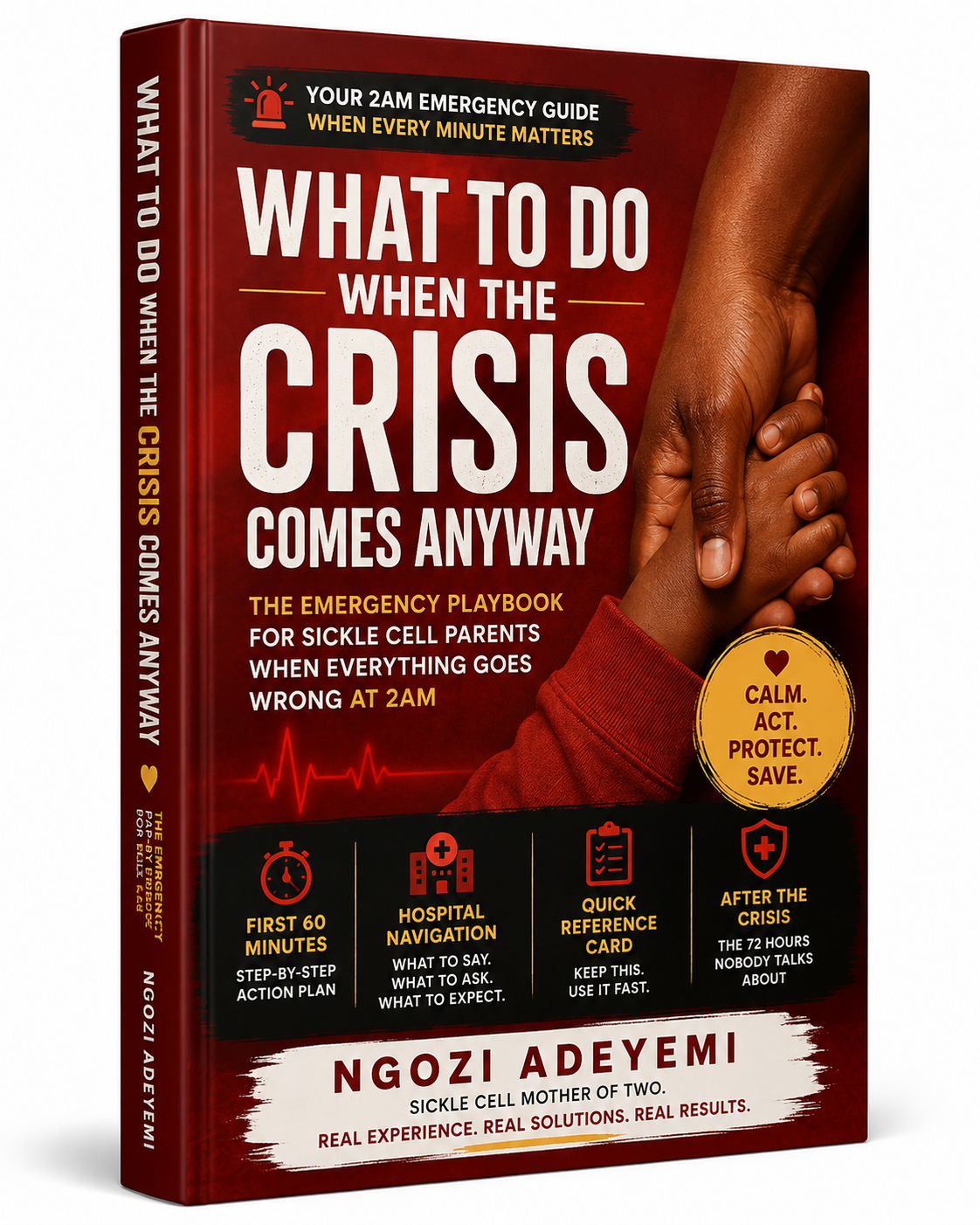
The main guide prevents crises. This bonus is for the moments when a crisis happens anyway — because even with excellent management, they sometimes do.
This is not a book for calm mornings. It is a book for right now — for the parent standing in the hallway at 1:47am who needs to know exactly what to do in the next sixty minutes.
Inside: The 15-minute crisis assessment. The 60-minute home intervention sequence. What to say when you walk into A&E. The medications to ask for by name. The post-crisis 72-hour recovery protocol. And the complete Crisis Quick Reference Card — designed to be read in 30 seconds with shaking hands.
Save it to your phone tonight. Before you need it.

- The 11 Triggers — Main Guide (38 pages)
Individual value: ₦9,800 - BONUS: What To Do When The Crisis Comes Anyway — Emergency Playbook
Individual value: ₦7,500 - The 30-Day Trigger Identification Diary — Printable tracking system
Individual value: ₦2,500 - The Crisis Response Card — Printable emergency card
Individual value: ₦1,500 - The Teacher Communication Template — Ready-to-send letter
Individual value: ₦1,200
Right Now, You Have Two Choices
Choice 1 — Close This Page
- The crises keep coming on the same unpredictable schedule
- You keep leaving hospital appointments with pamphlets that explain nothing
- You keep spending money on consultations that treat the crisis but never the ground it grows from
- Your child keeps living with the fear of their own body
- You keep carrying this alone — the guilt, the vigilance, the 2am terror — without a map
Choice 2 — Take The Protocol
- You understand — for the first time — what is actually happening inside your child's body
- You identify your child's personal trigger profile within 30 days
- You catch the 72-hour early warning signs before they become full crises
- You feed your child's blood with foods already in your kitchen
- You stop being a passenger in your child's illness and start being the pilot
The difference between those two paths is a decision made in the next sixty seconds.
🛡 30-Day Money-Back Guarantee
Take the guide. Follow the protocol completely — the trigger tracking, the dietary adjustments, the hydration formula, the daily morning checks — for 30 full days. If after 30 days of genuine, consistent implementation you have seen no measurable change in your child's trigger profile or crisis pattern, contact me directly and I will refund every naira. No interrogation. No conditions. No waiting.
I can make that promise because I know what this protocol does when it is followed. The risk is entirely mine.
Follow it. Give it 30 days. Then decide.
One Last Thing.
Picture yourself one month from today.
Your child's trigger diary is open in front of you. Four weeks of daily entries. A clear pattern has emerged — you know which triggers are primary for your child's specific body. You have eliminated two of them entirely. The others you are managing systematically, daily, without drama.
Will you look at that diary and feel something you have not felt in years — the quiet confidence of someone who understands what is happening and knows what to do?
Will your child go to school this week without you spending the morning watching for signs, calculating risk, waiting for a message from the teacher?
Will you sit across from the hospital consultant at your next appointment and ask questions you have never known to ask before?
Will you send the Teacher Communication Template and feel the particular relief of knowing that the people responsible for your child during the seven hours a day you are not there — actually know what to do?
Will you sleep through a full night without listening for sounds from your child's room?
Now picture yourself one month from today if you close this page.
The crises come on the same schedule. The hospital bag stays packed in the corner. The guilt stays. The not-knowing stays. Every morning you check the lip colour and wait.
The difference between those two versions of you is a decision you make in the next sixty seconds.
I Choose the Map — Get Me The 11 TriggersIf you have read this far and you are still hesitating —
I want to ask you something honestly.
Is it that you do not believe the protocol works? Because two hundred families have now used it and the results speak for themselves.
Is it the price? Because ₦5,000 is less than one pharmacist visit. Less than one private consultation. Less than the fuel you spent driving to the hospital last month.
Or is it something quieter than that. Something that sounds like: I have tried so many things. What if this one doesn't work for us either? What if I get my hopes up and it fails?
I understand that voice. I carried it for six years. It is the voice of a parent who has been disappointed so many times that hope itself has started to feel dangerous.
But here is what I know about that voice — it is not protecting you. It is keeping you exactly where you are. In the same hospital. In the same car park. Holding the same discharge letter.
You have a 30-day guarantee. The risk is gone. The only thing between you and this information is a decision.
If you cannot invest ₦5,000 in a protocol that gives you a map for your child's most vulnerable condition — how much longer are you willing to navigate without one?
Stop hesitating. Choose your child. Choose yourself.
I Am Ready — Get The 11 Triggers NowP.S. — Remember: you have a full 30-day money-back guarantee. Follow the protocol completely for 30 days. If you see no measurable change in your child's trigger pattern or crisis frequency — contact me and I will refund you in full. You have nothing to lose except the information. And the information might change everything.
P.P.S. — This ₦5,000 price is only available for the first 50 parents. After that, the price returns to ₦9,800. If you want the discounted price, today is the day.
P.P.P.S. — Every day you wait is another day your child enters the world without you knowing their trigger profile. Another day of guessing. Another morning of checking the lip colour and hoping. The protocol takes 30 days to show you the full picture. Every day you delay is a day later you have that picture. Start tonight.
With love for your child and respect for the weight you carry,
Frequently Asked Questions
How is the guide delivered after payment?
Immediately after your payment is confirmed on Nestuge, the guide is sent to both your WhatsApp number and your email address — within 60 to 90 seconds. You do not need to wait for manual processing. The delivery is automatic and instant. You can be reading the guide within two minutes of completing your payment. The guide arrives as a PDF file that you can read on your phone, print at home, or open on any device. The Emergency Playbook bonus arrives in the same delivery.
Are the ingredients and foods in this guide easy to find in Nigeria?
Yes. Every food recommended in the Nigerian Kitchen Sickle Cell Protocol is a standard Nigerian staple available at any local market — ugu leaves, crayfish, titus fish, beans, sweet potato, watermelon, oranges. Nothing exotic. Nothing imported. The total cost of implementing the full dietary protocol from day one is less than ₦3,000 per week — and most families are already buying most of these ingredients. For those in the UK, the diaspora adaptation section translates every ingredient to what is available in African grocery stores in London, Birmingham, Manchester, and Leeds.
My child has very frequent and severe crises. Will this still work for us?
The guide includes a specific section for children with high crisis frequency — those who are crising more than three times per year or whose crises are consistently severe. Chapter 4 addresses the trigger stacking pattern that typically underlies high-frequency crisis cycles and provides an accelerated trigger identification approach for families where the situation is more urgent. The Emergency Playbook bonus is particularly important for families in this situation. This guide does not replace your medical team. For children with very severe or frequent crises, medical supervision remains essential. What this guide does is fill the enormous practical gap between what your medical team provides and what you need to manage the condition every day at home.
My partner thinks I am overcomplicating things. What if they are not supportive?
This is more common than most people admit. The guide addresses this directly. Chapter 7 includes a framework for introducing the protocol to a skeptical partner in a way that invites participation rather than triggering resistance. The guide is also designed to be implemented largely by one parent — you do not need your partner's active participation for the protocol to work. Many mothers have reported that once their partner saw the results — fewer crises, green trigger days, a child with more energy — they became genuinely engaged with the process. Results are more persuasive than arguments.
Is the 30-day money-back guarantee real?
Completely real. If you follow the protocol as described — the daily trigger tracking, the dietary adjustments, the hydration formula, the morning checks — for 30 full days and see no measurable change in your child's trigger profile or crisis pattern, contact me directly and I will refund your full payment. I offer this guarantee because I know what the protocol does when it is followed consistently. In two years of sharing this approach with sickle cell families, I have processed three refund requests. Every other family who implemented it completely reported measurable improvement within the first month.
How is this different from everything else I have already tried?
Most sickle cell management advice operates at the level of general principles — stay hydrated, take your folic acid, avoid cold, manage stress. This guide does not argue with any of that. What makes it different is specificity. The 30-Day Trigger Identification System gives you a structured methodology to identify YOUR child's specific combination of triggers in YOUR child's specific life context. The result is a personalised trigger profile that no general guide can give you because it can only come from 30 days of observing your specific child. Additionally, the Nigerian Kitchen Protocol is built entirely around Nigerian and African diaspora food contexts — not American or European frameworks adapted for African families. The foods recommended are the foods you are already buying. That specificity is the difference between advice that makes sense in theory and advice that changes behaviour in practice.
✓ What To Do When The Crisis Comes Anyway — Emergency Playbook Bonus
✓ 30-Day Trigger Identification Diary (printable)
✓ Crisis Response Card (printable)
✓ Teacher Communication Template (ready to send)
🛡 30-Day Money-Back Guarantee. Follow the complete protocol for 30 days. If you see no measurable improvement in your child's trigger profile or crisis frequency — full refund. No questions. No waiting.
The Warrior Parent Blog
Real Help For Sickle Cell Families
© 2026 The Warrior Parent Blog. All Rights Reserved.
The information on this page is for educational purposes only and does not replace professional medical advice. Always consult your child's medical team. In emergencies, seek immediate medical care.
Comments (214)
I bought this guide two weeks ago and I have been sharing the link with every sickle cell mother I know. The trigger identification diary is genuinely brilliant. By day 10 I could already see a clear pattern — my daughter's worst weeks always followed late bedtimes and high-carb dinners. I never would have connected those things without the tracking system.
Like (47)What I appreciate most is that this guide does not talk down to me. The plain-language body map in Chapter 2 — where it explains what sickle cell actually does inside the blood during a crisis — I have read it three times. I finally understand what my son's body is going through. That understanding alone changed how I respond to him during difficult days.
Like (61)I am a father reading this. Most sickle cell resources seem to be written for mothers. But this guide speaks to fathers too. I have recommended this to the three other fathers in my sickle cell parent WhatsApp group.
Like (38)The Teacher Communication Template is worth the price of the guide alone. I sent it to my son's class teacher and his school nurse. Two weeks later, the teacher messaged me to say she had noticed my son looking pale one afternoon and had given him water and let him rest — before a crisis developed. My son did not go to hospital that week.
Like (92)I have been a sickle cell mum for eleven years. I thought I knew everything. This guide taught me three things I did not know — the trigger stacking concept, the specific role of gut health in crisis frequency, and the post-crisis 72-hour vulnerability window. Eleven years and I was still missing critical information. Please buy this guide.
Like (84)The emergency playbook bonus is incredible. I have the Crisis Quick Reference Card laminated on my fridge, saved on my phone, and printed inside my daughter's school bag. Last month her after-school club supervisor used it when my daughter started showing signs. She followed the card exactly. First time anyone outside our house has ever responded correctly to her early warning signs.
Like (73)My son has been on the protocol for 6 weeks. Two amber days caught and managed at home. Zero hospital admissions. For a family that was going twice a month at our worst point — this is a completely different life.
Like (66)Share Your Experience